Sunday, October 2, 2011

Yakutat Glacier, the end of a project


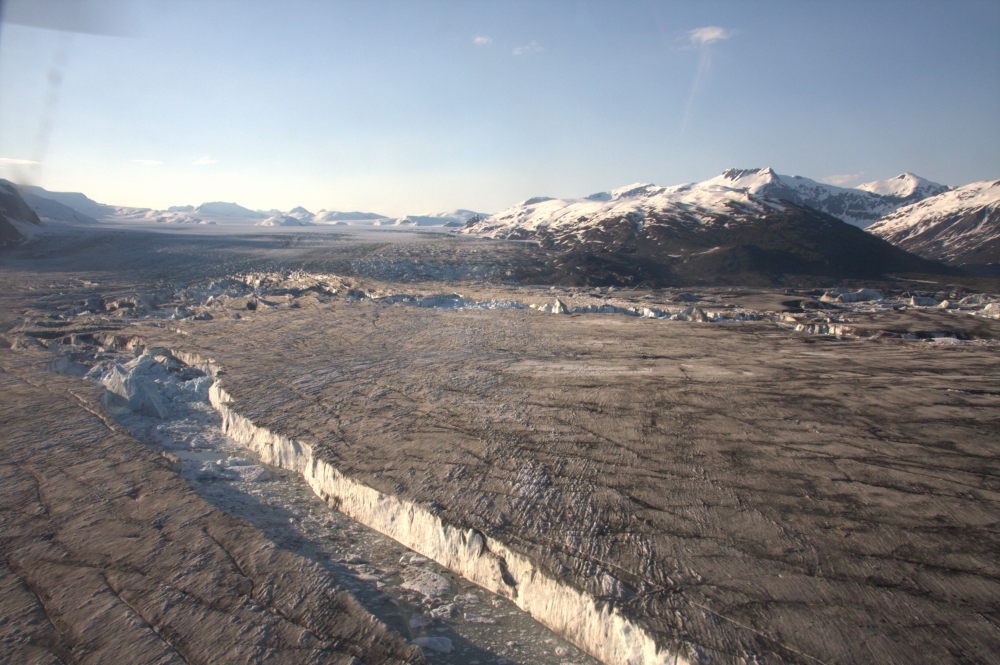
Two weeks ago we were back on Yakutat Glacier for one last time, at least with regards to this particular NSF funded project. It is amazing how much the glacier has changed. In fact, it has become two glaciers! The eastern branch (right side of the image) is no longer connected to the western (main) branch. During this three-year research grant, the glacier has lost several square kilometers of ice that has broken up into the lake. In fact, we almost lost some GPS receivers. We had to pick up two of them on icebergs that had already calved. They survived the event and were still recording.
This picture (from R. Motyka) nicely shows why this ice field is in trouble. It was taken a week ago, and nowhere on the glacier is there any sign of snow from last year. That means that the glacier is not gaining any new ice in most years, even at its highest elevations. It has to melt away. And things are only getting worse: As it's getting thinner, it finds itself at progressively lower (and warmer) elevations.
I'm curious how it will look in 20 years.

Tuesday, August 30, 2011

A boat trip to the fjord

Most of the rapid changes in glaciers that we are currently observing are related to changes in the oceans. So it is increasingly necessary to make direct observations of ocean conditions in front of glaciers. But that's not always so easy:


The answer is to hire a small boat that can handle impact from ice
and a capable crew (skipper Hans and deck hand Peter):

We spent a week in the inner fjord measuring temperatures, salinities and currents in the ocean.
We also deployed some drifters that will float out with the water. They report their positions with measurements of the upper water column every half hour via Iridium satellites.
We spent the nights at a protected little bay, with beautiful sunsets (before the weather turned lousy), and reindeer and fishing nearby. Peter, the Greenlandic deck hand, is also an avid hunter and fisherman and provided us with fresh food.

Near our anchorage, one could still find the remains of foundations from Norse settlements. The Norse had lived in this area for several hundred years during the medieval optimum, and finally disappeared with only few traces left.


Monday, August 29, 2011

How fast does a glacier flow?

One of the main things we are often interested in is the speed of glaciers, and how variable it is. For that we use a variety of methods. GPS works really well, but low down on tidewater glaciers, there are so many crevasses that we don't like to leave expensive instruments. This year we had an exciting opportunity to test a new method. It measures the displacement of ice by looking at the difference in returned radar phase. It is possible to get a velocity field within a few minutes of measurements only. The image below shows the instrument, which we had on loan from Gamma Remote Sensing.


To verify the results of the radar we also did some more traditional surveying. For this we deployed targets onto ice towers (seracs) from a hovering helicopter. These targets consist of a prism reflector, which is then surveyed with a total station from the side of the glacier.


Sunday, August 28, 2011

Back in Nuuk

We're back in Nuuk, Greenland. This is the key field work for our proposal, in which we try to better understand ice-ocean interaction. The planned work involves detailed observations of conditions in the fjord and of the variation and details of glacier flow near its front. We have two teams, one camped at the glacier front and one in a small boat.
Getting out was delayed a bit. Nuuk has been having problems with low fog. Even when we finally left, it was through a small hole in the fog. Just a little distance away from town, the weather turned nice.


The first task was to fly back to GPS stations that are far up on the ice and that are designed to run all year. At this particular station, a little over 1.5 m of ice had melted. The box with batteries and instruments slid around a bit, but everything was working fine. We don't always find things in such nice condition!The main work is to observe conditions at the glacier front, however. One important observation is the release of fresh water from the base of the glacier. Because it is fresh, it raises right to the top and creates a surface plume at the glacier front. The upwelling water brings lots of stuff with it, and when we fly over, we can sometimes see hundreds of birds feeding there.


Tuesday, August 16, 2011

Susitna Glacier


Ok, so this comes a bit late, but in June I joined Sam Herreid on a quick trip to Susitna Glacier in the Alaska Range. We were putting in a camera to observe the glacier. It's a surge-type glacier, which means that it can accelerate to almost 100 times its normal rate of flow in a few months. It last did that in the 1940s. The combination of normal flow and surges creates these beautiful looped moraines.Susitna Glacier is also interesting, because there are serious efforts under way to build Alaska's largest hydroelectric power plant in its drainage area. This requires some careful thought about how the discharge will evolve, as the glaciers in this area are generally retreating, and how much sediment is being put into the river, in particular if another surge should occur.
We put in the camera by piggy-backing on another project, which got us a helicopter ride in. On the way back we relied on a pack raft, a first one for me.


Monday, May 30, 2011

Yakutat Glacier, still falling apart


We are just back from Yakutat Glacier, one of the most rapidly retreating glaciers in the world. These icebergs came off the glacier last September and are currently stuck on an old moraine in the lake. The lake is generally very deep (over 300 m), but at this location an old sill keeps icebergs from floating down lake.

Yakutat Glacier has lost several square kilometers of surface area in the past few years, and no end is in sight. Large rifts are still forming on its floating tongue and further retreat is guaranteed.

Last year we measured the ice thickness using an ice penetrating radar, and we found that all of the glacier base is very close to sea level. Harlequin Lake, into which the glacier now calves, will keep growing for quite a while!

Friday, May 13, 2011

Icy Bay

Icy Bay is located along the coast of Alaska, northwest of Yakutat. It must be among the most amazing places on Earth. My colleague Chris Larsen has led a project there to study tidewater glaciers and icequakes. We went there to help him rescue a camera. Glacier pilot extraordinaire Paul Claus got us there in his Supercup


There are several glaciers entering the bay. We went to Yahtse, which is among the few advancing glaciers.
It is quite overwhelming to stand in front of this large and unstoppable mass of ice.

The small orange box contains a camera to monitor the glacier advance. We came just in time to move it ahead of the advancing ice.Back from a successful mission, Chris is contemplating the vastness of the place...
The mountain goats love the steep slopes here. They seemed to be about equally curious about us as vice versa.
And on the flight back: A nice view of Mount St. Elias and the Tyndall Glacier. You are looking at 5400 m (18,000 ft) of elevation difference in this picture!