Friday, March 29, 2013

The Wrangell-St.Elias Mountains

Yesterday we had one of these rare days with clear weather along Alaska's coastal mountains. We took advantage of it with a long day of surveying. This gave us a chance to see some of the most spectacular mountain landscapes on this planet.

First we flew Yahtse Glacier in Icy Bay. Icy Bay is an incredible place. The mountains rise straight out of the sea up to the towering 5,400 m high Mt. St. Elias.
Wind scouring patterns on Yahtse Glacier

Upper Yahtse Glacier


Looking down the steep terminus of Yahtse Glacier

Icy Bay

Yahtse Glacier, one of Alaska's few advancing glaciers
Icy Bay

After Icy Bay we headed south-east along the coast across the vast expanse of Malaspina Glacier.


Next was Yakutat Glacier, a place we had studied extensively during the past few years as part of an NSF funded project. Yakutat Glacier is one of the most rapidly retreating glaciers in Alaska. It calves into a lake and has lost several kilometers of its frontal area in just a few years. The glacier front is hard to recognize compared to just two years ago.


The front of the West Branch

Crevasse patterns on the West Branch
The East Branch still has some floating ice, but it is rapidly breaking apart

Next up was the Hubbard Glacier, North America's longest tidewater glacier

Hubbard Glacier is healthily advancing. Twice already it has pinched off Russell Fjord at this location. In the back is Turner Glacier, Alaska's only surging tidewater glacier. It is surging again, for the third time in just ten years

The tide is moving glacial silty water into Russell Fjord

Some impressions from the upper Hubbard Glacier


Is Logan Glacier surging?

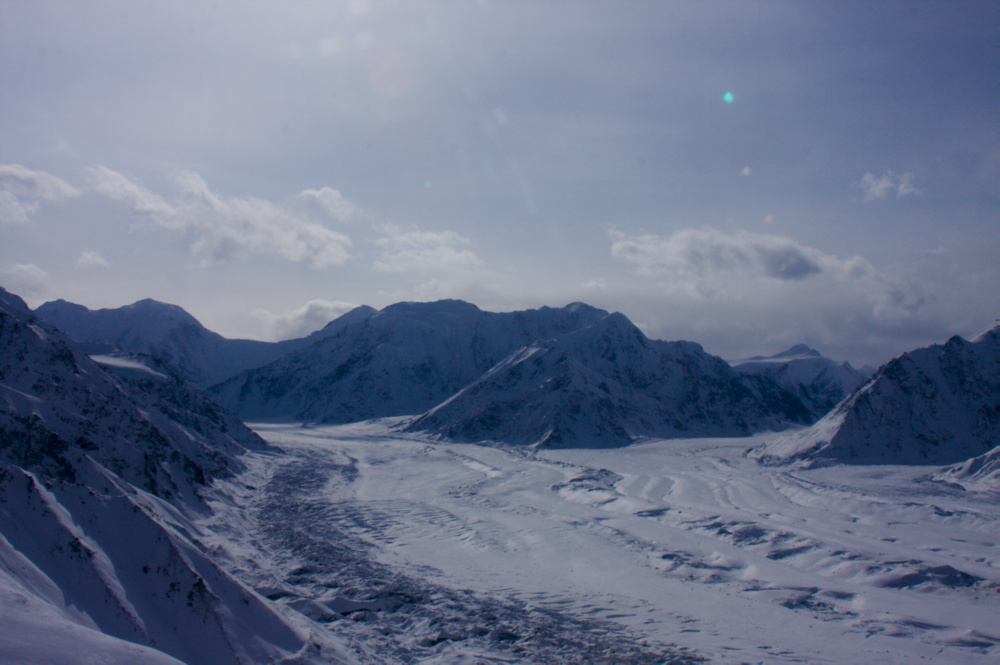
Three days ago we surveyed the Logan Glacier, which flows from Mt. Logan (North America's second highest mountain and Canada's highest) into the Chitina Valley. During the survey we saw signs of a surge. This glacier is not known to surge, but some unmistakable signs include very active shear margins and crevassing, and a bulge that is expected to travel down glacier over the coming months.
Shear margin with active crevasses
Ice bulge with lots of new crevasses
Paul enlists Chris' help to check the engine on his plance


A draining glacier lake left this pattern as the ice collapsed

Airborne radar

 This week we are based at Ultima Thule Lodge, from where we conduct airborne radio echo sounding measurements to find out how deep the glaciers and ice fields are. The lodge is located in the middle of the Wrangell-St.Elias National Park and provides easy access to some of the biggest glaciers and ice fields outside the polar regions.


 The lodge is located in the Chitina valley, an expansive valley with steep side walls and many water falls that form spectacular ice falls in the winter.


The valley is also a favorite place for sheep and goats. Can you spot the one behind the ice pillar?


Friday, January 18, 2013

PIG - the movie

Forrest McCarthy was a mountaineer on our PIG expedition. Mountaineer is a strange term, since it is about as flat as it gets there. But he, together with Einar Steinarsson, was responsible for safe conduct in the heavily crevassed areas. He put together this nice video of field impressions


Thursday, January 17, 2013

PIG – The crack


The Pine Island Glacier flows into the ocean. It loses mass by melting of ice by warm ocean water from underneath and by calving big ice bergs. Calving happens every few years, when a big ice berg is released into the ocean. The satellite image below (collected by TerraSAR X) shows a crack where the next ice berg is about to be released. This radar picture was taken in early January. Not only does it show the crack, but the linear feature at the lower right shows the snow machine traverse track between our different field camps!

Our field site was only 20 km away from the crack, so we got to fly over and have a look.
Snow drifting into the crack

The crack in early December. It is almost entirely connected across the shelf


Airplane shadow in the crack

Wednesday, January 16, 2013

Master driller Dale


Dale Pomraning (here with Penn State grad student Kiya Rivermann) is our hot-water drill extraordinaire. When we came back to the main camp at PIG, the camp manager, Dean Einarsson introduced us as: “Dale Pomraning and Martin Truffer, master driller and PI”. The way he said it seemed to refer to me as master driller, so Dale's feelings were hurt. Dean corrected this the next day with an official apology, which went along the following lines:

“Dale invented drilling in 1801. Before that people were mostly just digging in the sand with their bare hands. Since then he has been involved in many projects. Some of you might be familiar with Old Faithful? Since 1973, he has continuously drilled in Antarctica. He is the master driller for the PIG project. Martin does not know anything about drilling and mostly just stands around.”

Dale accepted the apology.

Tuesday, January 15, 2013

Drilling through the PIG


The PIG is the Pine Island Glacier in Antarctica. It is a huge glacier that drains into the ocean. The last part of it actually floats on the ocean and is melted from below by relatively warm ocean water. It is this melting that makes PIG such an important contributor to sea level rise from ice loss.

We spent most of December and parts of January drilling several holes through about 500 m of ice and then putting instruments into the ocean below. The instruments measure temperature and salinity of the ocean water underneath and the rate of melt at the bottom of the ice sheet.

It is a great relief to successfully complete this season after last year was essentially a total bust. We had fantastic support from NSF and the logistics people, which made this possible.

Our camp was put in with a Twin Otter on loan from the British Antarctic Survey. The Twin Otter is the workhorse of Antarctica. Once on the ground we moved all our equipment and camp with snow machines.

 
The camp consisted of two larger tents, one a kitchen, and one a galley for up to 14 people. We slept in the smaller mountaineering tents.

The hot water drilling operation works by pumping water out of a pool, heating it up to about 70 deg Celsius and pumping it down a hole. The water is then recovered and pumped back into the pool.

The heaters are essentially the same that are used to produce high pressure hot water at car washes. The pump is in the back left and is configured to pump a constant 20 gal/minute at high pressure.

The hot water is routed into the borehole via a capstan winch. We drilled at a speed of between 65 and 95 meters per hour. The drilling speed decreases with depth, because the water at the drill tip gets colder as the hose descends into the borehole.
The orange hose behind the winch is used to pump water back out of the hole for recirculation.

Once the hole is finished a variety of science takes place. We used a borehole camera to image the hole, we dropped a sediment corer to the bottom of the ocean to find a record of past glacier advance and retreat, and then installed instruments to measure salinity, temperature, and water fluxes in the ocean below the shelf. In this picture Jim and Tim from the Naval Postgraduate School in Monterey lower a flux package instrument with a string of thermistors to measure ice temperatures in the bottom part of the ice shelf.

Hot water drilling offers great benefits, such as a warm hose for naps, hot water for showers, hot tubs, and laundry.