Saturday, May 9, 2020

Black Rapids in the time of Corona

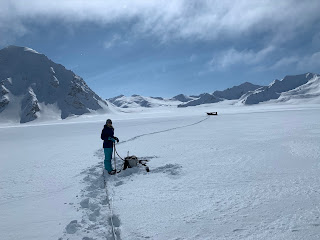
Each year we make a visit to Black Rapids Glacier to keep track of its mass loss or gains (mostly the former). The time series goes back to the early 1970s, but for the past decades it has not been funded anymore. We've been able to keep it going thanks to friendly helpers with airplanes. This year we were delayed for quite a while by weather, Covid-19 restrictions, and airplane maintenance issues. But then finally things aligned and the last two weekends we had perfect weather conditions. I enlisted my daughters as helpers, that way we didn't have to break any social distancing rules. I have not yet finished looking at the data, but it is already clear that 2019 was one of the biggest melt years in the entire, almost fifty year, record.


Wednesday, February 19, 2020

Big skies at Thwaites

I loved the cloud formations that we saw at Thwaites, especially when the weather was changing and new fronts moving through. Here's a selection:


Monday, February 17, 2020

Drilling through the Thwaites Glacier

The last time I wrote here we were desperately trying to get out of McMurdo and onto the Thwaites Glacier. It's a long journey to a very remote location, so nothing comes easy. But, by now, I am comfortably back in Alaska (although it is colder here than it has been in Antarctica ...).

But all in due order. On 13 December, after one month in McMurdo things all of a sudden started moving quickly. After two false starts with lots of waiting, I was part of an advance team to WAIS Divide, where a big camp was set up to receive major amounts of cargo. Once at WAIS Divide we immediately transferred from the big LC-130 aircraft to a Basler (a converted DC-3) and arrived that same day on our field site; the home for the next five weeks. During that time we were doing lots of surveying with radar and seismic methods. I was in charge of hot water drilling. We completed two holes through the Thwaites Glacier Iceshelf, did some profiling of the underlying ocean, took sediment cores and installed ocean moorings and a fibre that allows us to monitor temperatures throughout the ice and water column. The work went very well, and we are now excited to see the data come in via satellite from one of the most rapidly changing places on this planet. More on the project and the whole collaboration is at thwaitesglacier.org

The Thwaites work is getting a huge amount of attention, for example from the BBC (although this report mostly covers a companion project with very similar goals).

Here are some of my pictures to give an impression of the work.

The Basler is a converted DC-3. This airplane was built in 1942, but was refurbished with new engines. It is now one of the power houses of Antarctic field work.
Here is the Basler and the other Antarctic workhorse, the Twin Otter. They have just landed at our field site.

Day 1: Still looking fairly well groomed

After a month on the ice my iphone face recognition didn't work all that well anymore...
Dale is taking stock of all our equipment that now has to be assembled

A radar survey team is slowly disappearing into a whiteout. We had to careful mark all routes, so we wouldn't get disoriented and end up in heavily crevassed area.


Our kitchen tent

Erin and Ted are cooking a yummy dinner

The hot water drill is set up: In the foreground are several diesel heaters that bring water to almost 80 deg C. In the background are two holding tanks. We pump water back out of the borehole into the holding tank, heat it up and then use it to drill through the cold ice.

The big wheel is a capstan winch over which the drill hose is guided into the hole. The smaller crescent guides another hose and an electric cable into the upper part of the hole. This is used to pump water back.

James is happy about the first sediment core from underneath the Thwaites Glacier iceshelf. Hopefully it will give us information about the history of ice cover in this area.


Drifting snow

One of our field guides, Blair, is ready for a cup of tea after some time shoveling tents out of the drifting snow.
After the storm

All our equipment is moveable by snow machine


Bruce pulling hose

James and Dale look a bit like two retired guys in Italy thinking about their next game of Boccia
Bruce is finishing up the AMIGOS installation.

And here it is after our camp was removed. This will be sending data for the next 2-3 years, we hope.
 
And here are Dale and I on the way out after 5 weeks on the ice

Back to WAIS Divide, the hub for all the activities on the Thwaites Glacier

Kenn Borek Twin Otter


Loading the drill equipment into a LC-130 Hercules


Sunday, December 8, 2019

Life in McMurdo Antarctica

It has now been over 4 weeks since I left our home in Fairbanks and we are still not on Thwaites Glacier where we plan to do our work. This is life when trying to get to such a remote place with all the gear we need to drill holes through that glacier. The logistical challenges are enormous: From the US Antarctic station of McMurdo we will fly several hours to a very remote field camp called WAIS Divide (WAIS is the West Antarctic IceSheet). From there we continue with smaller airplanes (mostly Twin Otters) for another several hours to our field camp on Thwaites Glacier. The weather in that part of Antarctica is notoriously bad, so we have been waiting patiently to finally get going. For the past week we have always been on the schedule to leave the next day, but then find ourselves disappointed, because the weather is simply not good enough, or the aircraft (ski equipped US Airforce LC-130 Hercules transporters) are not available.

So how does one spend the time waiting? First, there was quite a bit of training we had to do, plus all the cargo needs to be moved through the system and forwarded to West Antarctica. Other than that, we do have office space, so we can continue doing some of the work we didn't quite finish back in the US. There are a few recreational opportunities with hiking and skiing trails. One local highlight is a visit to Scott's Discovery hut. This hut was used by Robert Falcon Scott on his first Antarctic journey and also during his ill-fated attempt to the South Pole, where he was beaten to the pole by the Norwegians under Amundson, and where he and his men tragically died on the return journey. The hut is just a short walk from McMurdo and is well preserved.

Here are some pictures and impressions from the past two weeks.


Crevasse rescue training and learning how to travel with roped snow machines:


We also did an overnight trip to the ice near McMurdo to go through our camp gear and discuss the field camp set up. The tent in the foreground is a Scott tent, which is a very sturdy tent that has worked in extremely windy conditions. Behind it is and Arctic Oven tent (made in Fairbanks) that will serve as our kitchen and mess.


Mt. Erebus is our local volcano and it is active with frequent steam plumes.
Beautiful wind clouds


This is a Delta, a large wheeled vehicle for travel over the snow roads to get to the local air field.

The local airport, where all ski equipped aircraft operate.

The New Zealand Antarctic base is just a short distance from McMurdo and is connected by a road.

There are some nice skiing opportunities on the sea ice.

Thanksgiving Dinner is a serious affair at McMurdo and the kitchen goes all out for a wonderful meal.


The nicest local hike is up Observation Hill, where a cross commemorates the death of Scott and his South Pole party.

This is Scott's Discovery Hut, still largely intact.

Some mutton survived the past 100 years

This is some seal blubber that was left behind. Still looks somewhat fresh, but I wasn't tempted to try ...


Seals on the sea ice

McMurdo from Hut Point (where Scott's Discovery Hut is located)

A common sight each morning. Flights to WAIS Divide are cancelled ....